Earlier this week, I saw someone post a real speaking opportunity in one of the speaker groups. The request was spelled out plainly, and after the responses came in she wrote a second post about what she had actually received.
She got more than 80 responses. She said one reel ran five minutes, and the speaker spent three and a half of them on his own bio. Others speaker rrels were shot so tight you couldn't tell there was an audience in the room at all or it was obviously fabriafcted, which is a thing I went on about at some length last week, so I won't hop back on that particular soapbox. Others were totally off base and irrelevant.
With content easier to create than ever before, it is easy to spin up new “facts.” I would surmise that quite a few of those applications had fudged facts—I see it all the time in speaker and consultant bios. They are the world’s first X or the world’s greatest Y or the world’s bestest Z. Almost as bad as fudged facts are the laundry lists of every single credential shoved into a one paragraph bio that says nothing meaningful.
I used to be the worst offender with my bio
Before I throw a single stone here, I can say I’ve learned from my own failures in this area.
A few weeks ago I was brave enough to pull out one of my old intros that read it to a group of speakers as what not to do. It went something like: “Entrepreneur, speaker, consultant, and author, who has worked across marketing, startups, leadership, hospitality, venture capital, and business strategy, and who has been featured in roughly every outlet that owns a logo.” I got most of the way through it, stopped myself, and said, "I'm done reading."
Every word of it was true. It also had laundry list syndrome, no hierarchy, no clear audience, and just so much garbage in it that no one cared about.
It took me years and a brand coach to learn it: if it matters to everybody, it matters to nobody, because when you're writing to everybody, you're really writing to nobody. I wish I could credit the exact person who originated that phrase, but I’ll chock it up to my brand coach.
The same tools that fake it are the ones that catch it
It has never been easier to make something. A reel, a headshot, a bio, a wall of logos, all of it takes minutes now, and the output looks expensive.
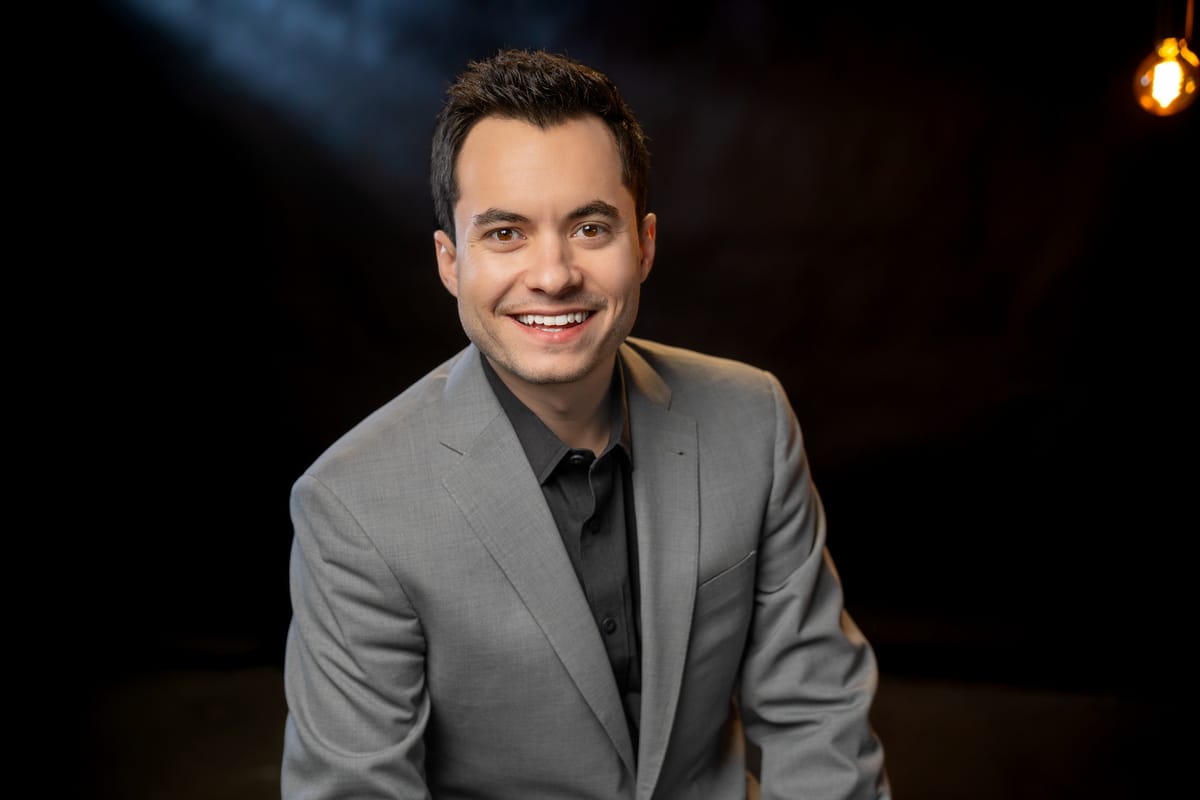
I was just sent a link to a podcast I was recently on where my headshot was AI-generated. I keep a meeting profesionals page on my site with multiple headshot options built specifically for meeting professionals, so the real ones were sitting right there, and somebody still decided to generate me in a pose I would never naturally sit in, holding props I would never naturally have. I am sending them ane email after I get this newsletter out….
But here is the part I think many speakers and thought leaders are missing…The same AI tools that can generate fake sites and speaker videos can also detect the fakes.
So this past week I took the liberty of fact-checking some of my own stats and then some of my speaker friends. I took some people whose bios say bestseller, or say they've done X, Y, and Z. I just asked the LLMs (ChatGPT, Claude, etc). Sometimes the answer came back that yes, this is verifiable, and here's the list. Other times it came back with "self-described," or with a note that the claim couldn't be independently verified.
This is really important for everyone to realize. These answer engines don't just simply repeat what you put out on your blog or on your website. They also go looking for a source of truth, and they triangulate the data. If the only place on the internet where a claim exists is your own website, that isn't proof anymore, it's a red flag.
And buyers are starting to notice. I was recently booked for a corproate keynote because of a conversation someone had with Gemini. Someone else traveled halfway across the country to hear me speak because they found out about me through ChatGPT. I had another media host say that they verified my credentials using AI. So, while AI can create these beautiful headshots and large stage speaking engagements, it can also call you out.
When honesty pays off
I love a good speaker intro. They are hard to master. And a few weeks ago, I heard one I will never forget…I was sitting in the audience watching a friend of mine present, it was the first time I had watched her give a talk. The emcee got up to read her introduction, and when it got to the word bestseller the intro qualified it. “This speaker is a bestselling author, and by that she means her book sold five copies on Amazon between the hours of 2:00 and 3:00 a.m. in the category of Sports and Outdoors, Camping, Knots, Knots You Can Tie With One Hand.”
The audience was rolling. She had technically achieved bestseller status. But more importantly that that, she framed it honestly. The framing did more for her credibility than the claim by itself ever could have, because nobody walked out of there wondering what else she might be rounding up.
When everyone's a bestseller, nobody is
We are all storytellers. That's what speakers are, that's what consultants are, and framing something well is not the same as lying about it. I've said before that you can do something much smaller than it sounds and still describe it in a way that's completely honest and genuinely effective. What you can't do is make it up, and you shouldn't steal somebody else's thunder either.
If you've seen Elf, Buddy walks into New York's Best Coffee and congratulates every single little coffee shop in New York for having the best coffee, and that's roughly what a stack of 80 speaker bios reads like to a bureau owner right now. When everyone is a bestselling author, the words stop doing anything at all, and they stop doing it for the people who earned them too.
This past week I watched a speaker explain that he went from 17 followers on TikTok to 1,000,000 in 24 hours, by his own account, because he posted a comedic video showing how he'd Photoshopped a family photo. He didn't say he had sold a company for millions of dollars or was a best-selling author or anything else.
He picked one fact that was extremely interesting, and, in this case, was impressive, and shared it.
So the question underneath every line of your bio isn't whether it's impressive. It's what problem you solve, what you're known for, and what makes you the only one.
The secret to building a great bio as a speaker
Before you touch a word of your bio, build the boring thing first: an Authority Inventory, which is just every credential, number, stage, client, and story you could possibly claim, sitting in one private document where nobody sees it. Then go back through and write down, next to each line, where somebody other than you could verify it. Not your website. Somewhere else.
Then run what's left through the Authority Equation, which is Why You, Why Me, Why Others, and Why Not, and keep only the things that point straight at the problem you solve. This is the part I'm bad at, for the record. I didn't want to take anything out, and it took my brand coach saying "cut it, cut it, cut it" to every single line, including the subtitles of my own books, before any of it came out. Congratulations, you did a cool thing. It's just not important right now.
The whole Authority Equation workbook is free, right here. My old bio is still in it, so you can see exactly what not to do.
BOTTOM LINE: Anything can be manufactured now, which means anything can be checked now. Build the Authority Inventory before you touch the bio, write down where somebody other than you can verify each line, and cut everything that doesn't point straight at the problem you solve. When everyone is a bestseller, the only claim worth anything is the one somebody else will confirm for you.
Until next time,

P.S. Ask an AI who you are this week and read what it says back. If "self-described" turns up anywhere, that isn't an insult, it's a map of the claims you haven't made verifiable yet. Hit reply and tell me what it said. You don't have to tell me whether you fixed it.
HONEST ADVICE FROM RYAN, SPONSORED BY HIGHLEVEL
Lessons in Action

Which Line Is Actually Getting You Booked?
You're not going to figure out which part of your bio is working by staring at the bio. You figure it out by looking at what people actually ask you for when they reach out.
HighLevel is where I keep track of where inquiries come from and what they're asking about, which is how I can tell which lines are pulling the right buyers and which ones are quietly sending me somewhere I don't want to go.
This is my own advice. HighLevel just sponsors me to share it, and I may earn a commission if you sign up through my link. The editorial's all mine.
